Lake Ashi CruiseAn Independent Guide Check Availability

Lake Ashi Cruise, Hakone

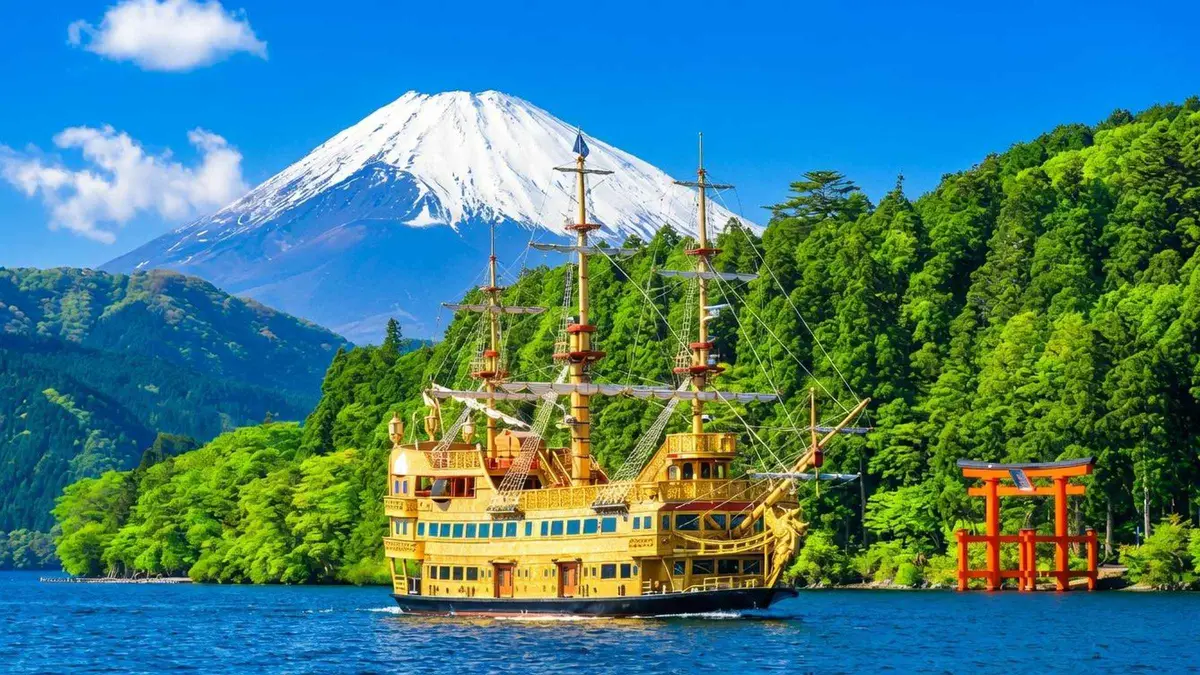
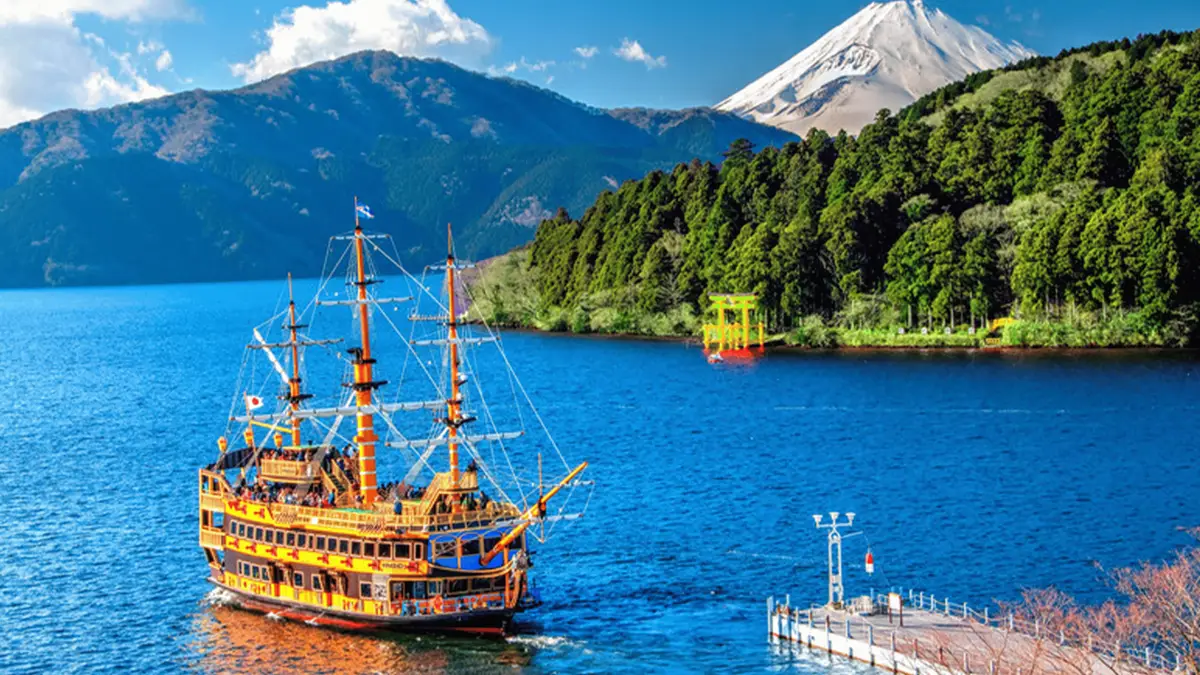
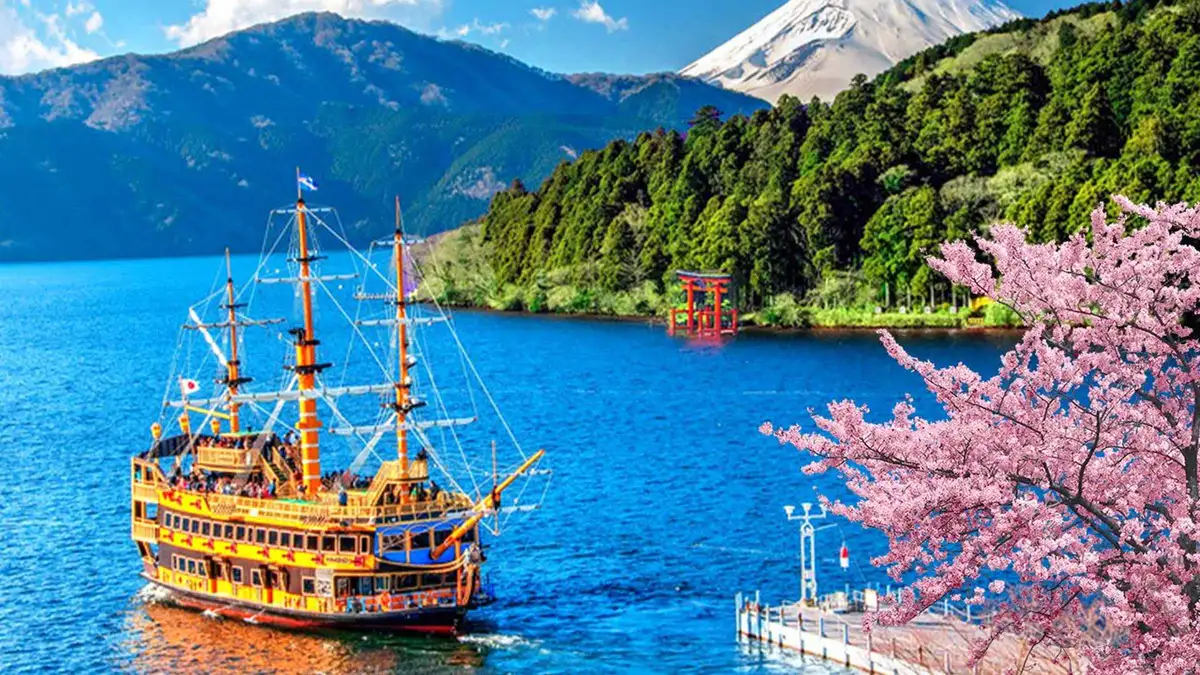
A Lake Ashi cruise crosses a crater lake 723 metres up, past a torii standing in the water with Mount Fuji behind it. What the crossing costs now, which port to start from, and which guided day tours actually pay for your ticket.

Updated August 2026

  • Fares checked against the operator's own notice
  • Free cancellation up to 24 hours on every tour listed
  • Rated 4.1 to 4.9 on GetYourGuide
Quick answer Fares, crossing time and what the tours leave out

A Lake Ashi cruise on the Hakone pirate ships costs 1,700 yen one way for an adult and 3,000 yen return, and the crossing from Togendai in the north to Hakone-machi or Moto-Hakone in the south takes 25 to 35 minutes. Those fares went up on 1 October 2025 and most guides still print the old ones. The catch travellers hit is on the tour side: most of the day trips sold under the words Lake Ashi Cruise do not include the boat fare at all.

Key takeaways

  • Adult crossing is 1,700 yen one way, 3,000 yen return, child 850 and 1,300. The full fare table
  • Guided day trips from Tokyo start around $49 with free cancellation up to 24 hours. Compare them
  • Our pick is the highest-rated day tour, 30 minutes at the pier, the ropeway in the fare, the lowest price on the page
  • Only the Kamakura day trip has the boat fare in its price, and that is the short ten-minute southern hop
  • The Hakone Freepass covers the pirate ships but not the Izuhakone boats from Hakone-en
  • Nobody can reserve a seat: you buy at the port counter and walk on, with about a 15-minute queue at peak

Hakone Day Tours That Reach Lake Ashi

Guided day trips that reach the lake, most leaving Tokyo by coach, one starting inside Hakone with a private guide. "From" is the lowest adult shared-group rate we read on the listing in August 2026; booking, payment and cancellation are handled by GetYourGuide. Read the boat column before you book, on most of these the crossing is an optional extra your guide buys at the pier.

Independent tour comparison
Last price check: August 2026
Fares verified against Odakyu Hakone's own fare notice
Traveller feedback reviewed: 10,000+ reviews

Which Tour Puts You on the Water Longest

Two columns decide this table. "On the lake" is the scheduled boat or pier time; "Boat fare" is whether that time is paid for. A tour can promise a cruise in its title and still hand you a 1,700-yen bill at the pier.

Tour Price Time on the lake Boat fare Ropeway Rating Book
Our pick Highest-rated Hakone day $49 30 min at the pier Extra Included 4.9 (923) Check Availability Details
Ropeway & Owakudani $54 25 min Extra Included 4.6 (7,741) Check Availability Details
Kamakura & Big Buddha $74 10 min Included None 4.5 (1,194) Check Availability Details
Slow Hakone day $65 25 min Extra Included 4.6 (129) Check Availability Details
Hakone & Enoshima $55 30 min Extra Extra 4.1 (55) Check Availability Details
Private, from your hotel $241 Your choice Extra Extra 4.6 (32) Check Availability Details

Every tour listed here is free to cancel up to 24 hours before departure.

The private tour starts in Hakone rather than Tokyo, so it is not competing on price with the coach trips, it is the option for travellers already staying at the lake, and the only listing here marked wheelchair accessible.

Live Availability and Prices

Live dates and prices for our pick, the highest-rated tour here, straight from the booking platform. Prices on this page were read from the listings in August 2026.

Powered by GetYourGuide

Checking one of the others? Ropeway & Owakudani day trip · Private bespoke Hakone day · Kamakura & Big Buddha day trip · Slow Hakone day with ropeway · Hakone & Enoshima day tour

What a Hakone Day Tour Actually Buys You on the Lake

The single most useful thing to know before booking any of these: the words in the product title are not the inclusions list.

Most tours sell the crossing as an add-on

On the most-booked tour the itinerary line for the Hakone Sightseeing Cruise is stamped Optional, Extra fee, and the inclusions list puts it under things you pay for yourself: "Hakone Pirate Ship Cruise fare on lake Ashi (Optional Activity around 1700JPY, you can ask the tour guide to purchase for you)". Our pick goes further, its booking options are literally named Excludes Pirate Ship, while the highlights above them promise you will "feel the breeze on your face as you sail on a pirate ship". The Enoshima trip and the slow Hakone day do the same.

None of this is a scam. The coach still takes you to the pier, the guide will queue and buy the ticket on your behalf, and if you skip the boat the vehicle runs you round to Togendai for nothing. But it means the real cost of a $49 tour is $49 plus 1,700 yen a head, and that a family of four is looking at 6,800 yen more than the listing price.

The one tour that pays for your ticket

The Kamakura day trip puts "Cruise on Lake Ashi" in its inclusions, and it is the only one on this page that does. The trade is written into the itinerary: ten minutes on the water, which is the short southern hop into Moto-Hakone rather than the full crossing, and no ropeway leg anywhere in the day. Read the option names carefully as well, the Basic "Only Mount Fuji" fare drops both the lake and the Great Buddha and takes you round five photo stops instead.

If what you want is the boat, the honest arithmetic is this: book the highest-rated tour at the lowest fare, hand your guide 1,700 yen, and you get a longer crossing, the ropeway and Owakudani for less than the Kamakura tour costs before you start.

Or skip the tour and use a pass

Travellers already staying in Hakone rarely need a coach from Tokyo. The private guide meets you at your hotel and moves by local train, bus, ropeway and boat, several of their reviewers mention buying a Hakone Freepass on the guide's advice and using it all day. That is the pattern to copy even without a guide: the pass turns the boat, the ropeway, the mountain railway and the buses into one tap, and the pass maths is where most of the saving sits.

Lake Ashi Cruise Fares and Tickets in 2026

Odakyu Hakone raised the fares on 1 October 2025. These are the figures in force now, taken from the company's own notice of amendment rather than from a travel blog.

The fare table

Between Togendai-ko in the north and either Hakonemachi-ko or Motohakone-ko in the south, the full crossing, the one nearly everyone rides:

- Adult: 1,700 yen one way, 3,000 yen round trip - Child: 850 yen one way, 1,300 yen round trip

Between Hakonemachi-ko and Motohakone-ko, the short southern hop of about ten minutes:

- Adult 600 yen, child 300 yen, one way

Before October 2025 the full crossing was 1,200 yen and the short hop 420. If a guide, a listing or a review quotes you 1,200 yen, it was written before the change and everything else on that page is the same age. The operator's own notice is published by Odakyu Hakone and the current tables sit on Hakone Navi.

The Special Cabin, and whether it is worth 800 yen

Every ship carries a Special Cabin sold on top of the normal fare: 800 yen per person for the one-way crossing, with 100 yen off for adults and 50 off for children holding a Hakone Freepass. Tickets are capped, so the cabin stays uncrowded when the main decks are shoulder to shoulder, and it comes with an outdoor deck reserved for cabin passengers.

Victory's cabin was rebuilt in April 2025 around a British-tradition theme, checkerboard floor, buttoned Chesterfield sofas, counter seats facing the windows. On a July weekend, when the open deck is a wall of phones, 800 yen buys you a place to stand at the rail. On a wet Tuesday in February it buys you a sofa you did not need.

How you buy, and why you cannot book ahead

There is no advance booking for individuals. Only groups of 15 or more can reserve; everybody else buys at the port counter and walks on to the next sailing. At peak times the queue runs around fifteen minutes, which is worth knowing if your coach has given you a fixed slot at the pier.

That also means the boat is one of the few things in Hakone you cannot lock in from home. Sailings are altered or cancelled outright in thick fog or strong wind, and there is no wet-weather substitute, on a guided tour the coach simply drives round the lake instead.

Which Hakone Pass Covers the Boat

Three passes touch the cruise, one of them badly misunderstood, and two more were withdrawn in September 2025.

Hakone Freepass

6,000 yen for two days, 6,400 yen for three, child 1,500 and 1,750, from 1 October 2025. It covers the pirate ships in the normal cabin as many times as you like, plus the Hakone Ropeway, the Tozan mountain railway and the Tozan buses. Special Cabin still costs extra each time, at the discounted rate.

The arithmetic that matters: the standard Golden Route leg, the crossing one way at 1,700 plus the ropeway one way at 2,000, comes to 3,700 yen. The pass only pays for itself once you add the mountain railway from Hakone-Yumoto, a second lake crossing, or the buses back down. One boat and one cable car on a single day is cheaper as two tickets.

Owakudani 2-Day Pass and the Cruise & Ropeway Pass

The Owakudani 2-Day Pass costs 5,000 yen adult, 1,300 child, and its ropeway validity was extended in October 2025 to the full Sounzan–Togendai run rather than stopping at Owakudani. The Sightseeing Cruise & Ropeway Pass is a one-day ticket at 5,000 yen adult, 1,400 child.

Two tickets are gone: the Hakone Sightseeing Cruise and Hakone Ropeway all-you-can-ride 2-day pass, and the Hakone Public Transports Single-Way Pass, both discontinued after 30 September 2025. Any guide still recommending either is at least a year out of date, a useful test to apply to the rest of that page.

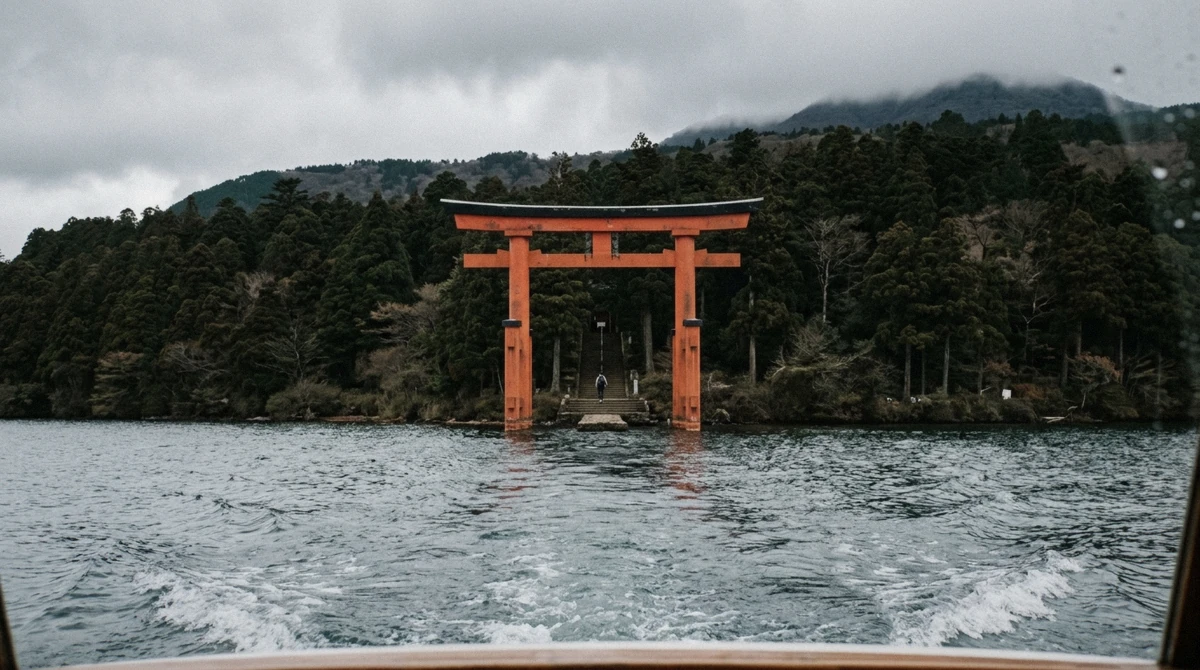
Red torii of Hakone Shrine standing in the water seen from the deck on a Lake Ashi cruise, Hakone, Japan
The shrine torii stands in the water off Moto-Hakone. Every southbound sailing passes it.

The Route and the Four Ports

Lake Ashi is a crater lake on the southwestern wall of the Hakone caldera: 723 metres above sea level, 7.03 square kilometres, 43.5 metres deep, with a 21.1-kilometre shoreline. Four ports ring it, and which one you start from decides your whole day.

Togendai, in the north

The ropeway terminus and the natural start if you are coming over the mountain from Sounzan and Owakudani. Buses from Hakone-Yumoto take about 46 minutes. Arriving here and sailing south is the classic direction of the Golden Route, and it is the direction the coach tours use, because it puts the torii and the shrine at the end of the crossing rather than the beginning.

Moto-Hakone and Hakone-machi, in the south

Moto-Hakone sits beside Hakone Shrine and the lake torii; its ticket centre was rebuilt in 2025 with a pirate-themed interior. Hakone-machi is a short walk from the reconstructed Hakone Sekisho, the Edo-period checkpoint that controlled the Tokaido road, and is the main boarding point for the galleons in the south. The two are ten minutes apart by boat at 600 yen, or a pleasant walk along the shore.

Hakone-en, and the trap

Hakone-en on the eastern shore is served by the Izuhakone boats, not the Odakyu pirate ships, modern vessels with large windows, run by a different company, with Hakone Sekisho-ato as their other southern port. They are perfectly good boats. They are simply not covered by the Hakone Freepass, and pass holders who board at Hakone-en find that out at the gangway.

Hakone-en is also where the Komagatake ropeway starts, which is why so many itineraries drift there by accident.

Where the Boats Call

Four ports, two companies. The Odakyu galleons work the triangle Togendai–Hakone-machi–Moto-Hakone; the Izuhakone boats work the eastern shore, and the Hakone Freepass is not valid on them.

Pirate ship ports (Hakone Freepass valid)
Izuhakone boats (Freepass not valid)

Two Boat Companies, One Lake

The commonest planning mistake at Lake Ashi is assuming every boat on the water belongs to the same operator.

Odakyu's pirate ships

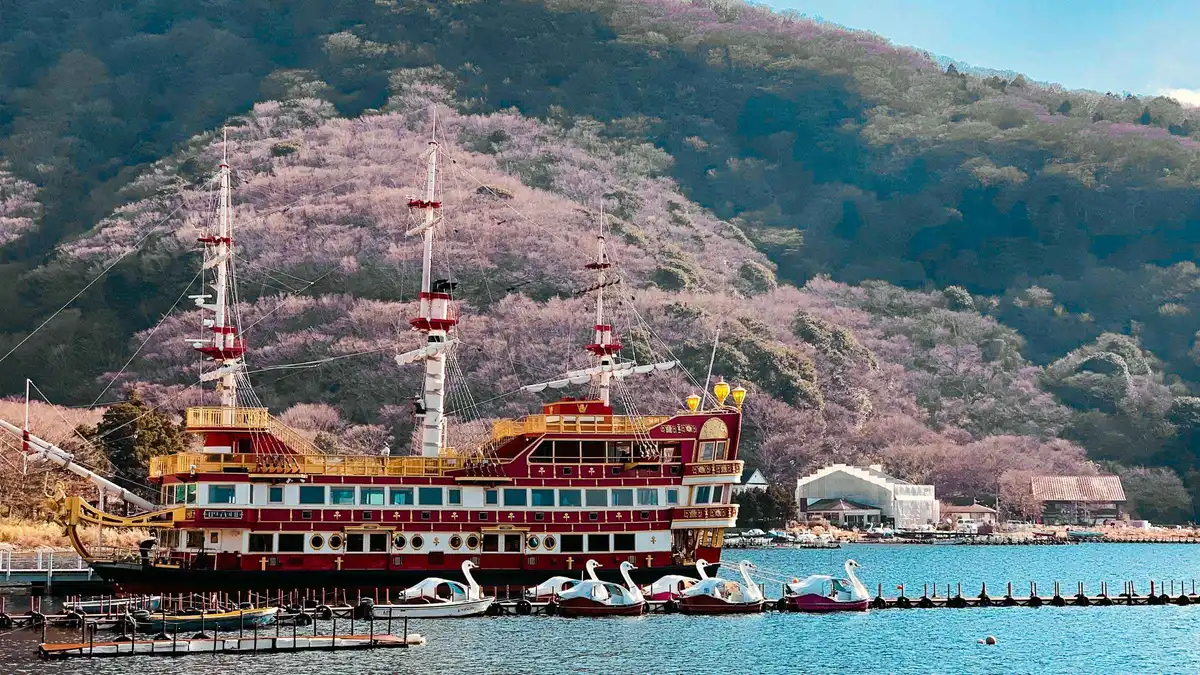
Three galleons run the Togendai to Hakone-machi and Moto-Hakone triangle. They are barrier-free, so a wheelchair user boards without leaving the chair, and each carries trick art, treasure chests and pirate sculptures inside, which is either the point or the price of admission depending on your taste. The Hakone Freepass covers these, unlimited, in the normal cabin.

This is what almost every guided tour means by "Lake Ashi cruise", and what the tours compared above put you on.

The Izuhakone boats

A separate company runs modern sightseeing vessels between Hakone-en and Hakone Sekisho-ato on the eastern and western shores, spacious interiors, big windows, no galleon rigging. Their thirty-minute round trip out of Hakone Sekisho-ato or Moto-Hakone is a quieter ride and shows you the same torii from the water.

The distinction only costs you money in one direction: the Hakone Freepass does not cover them. If you are pass-free and the pirate queue looks grim, they are a reasonable substitute. If you are holding a Freepass, walk to a pirate-ship port.

Riding the Cruise Yourself vs Booking a Day Tour

From Tokyo the cruise is a three-hour reach in each direction, which is what the coach tours are really selling.

Doing it independently

Odakyu's Romancecar from Shinjuku to Hakone-Yumoto takes about 85 minutes, then the Tozan railway and the cable car climb to Sounzan, the ropeway crosses to Togendai, and the boat carries you south. The full circuit is the Golden Route and it works without a single booking. Budget the 6,000-yen Freepass plus your Tokyo-to-Odawara fare, and reckon on leaving Shinjuku by eight if you want the whole loop and a stop at the shrine.

What you get: your own timing, the freedom to sit out a foggy hour, and the ability to ride the boat twice. What you give up: about ninety minutes of the day spent working out connections, and no seat on the way home.

Taking the coach

A guided day trip removes every connection and sets you down at Hakone Shrine around 10:30, with the pier, the ropeway and Owakudani in a fixed order and a driver waiting after each. The cost is control: stops run 20 to 80 minutes and the group leaves when the guide says so. Several operators warn in writing that August traffic can push the return past 20:00.

On price the two are closer than they look. The lowest-priced tour is $49 plus 1,700 yen for the boat, which lands near what a Freepass and a Romancecar seat cost on their own, and the tour includes the ropeway and the driving.

When to Ride, Month by Month

Two things swing with the calendar on this lake: whether Mount Fuji shows at all, and how cold the open deck is. Bars show the average daytime high recorded at Hakone town, in Celsius. The lake sits at 723 metres and runs three to four degrees colder than that.

Fuji visibility is markedly better in the cold months than in summer, and better early and late in the day than at midday. Every tour operator on this page states in writing that the view is not guaranteed, one of them warns about it three separate times.

What You See From the Deck

Twenty-five minutes is not long, and the good things are not evenly spread along the route.

The torii and the shrine

The vermilion Heiwa no Torii stands in the shallows off Moto-Hakone, belonging to Hakone Shrine, a foundation dating to 757, visited by shogun and samurai on the way over the pass. From the water you get the angle the queue on shore is waiting an hour for, and you get it for free. Sit or stand on the port side heading south.

The checkpoint and the caldera wall

Approaching Hakone-machi the shoreline carries the reconstructed Hakone Sekisho, the Edo checkpoint where every traveller on the Tokaido was searched. Behind it the caldera wall climbs; Mount Hakone last erupted in 1170 CE and the steam still leaking out of Owakudani is the same system. Ships pass close enough to read the checkpoint's roofline.

Mount Fuji, if it turns up

Fuji stands 3,776 metres beyond the northwest shore and is the reason half the passengers are aboard. It is also cloud-covered more often than not between June and September. Every operator says so in their terms, and the reviews bear it out, the same tour has travellers writing "we were lucky enough to have the visibility" one week and "pity it was cloudy" the next.

Ride early in the day and in the cold half of the year and the odds move your way.

Why There Are Pirate Ships on Lake Ashi

The single most asked question about this crossing, and the answer is more recent than most people assume.

Three galleons, none of them historic

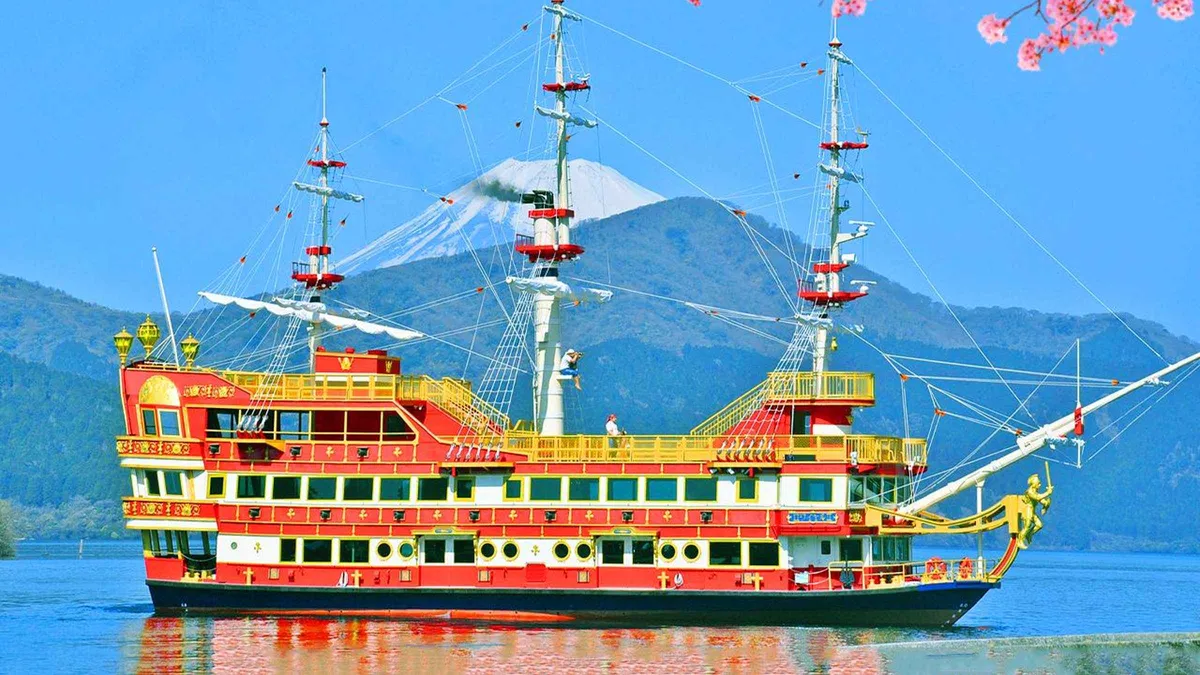
The Hakone pirate ships are sightseeing vessels built in the style of European sailing warships, and they have no connection to Japanese maritime history at all. Odakyu introduced the styling as a draw for family visitors, and it worked well enough that the fleet has kept it through successive replacements. The three currently working the lake are Queen Ashinoko, Royal II and Victory.

Inside they carry trick art, treasure chests and carved figures, which lands better with children than with anybody else. Outside they are ordinary double-hulled sightseeing boats, which is why they are stable enough for open-deck viewing in the wind that runs down the caldera.

How long the pirate ship ride takes

Twenty-five to thirty-five minutes from Togendai in the north to Hakone-machi or Moto-Hakone in the south. A there-and-back ride runs 70 to 90 minutes with the port stops. The short hop between the two southern ports takes about ten minutes.

All three ships are barrier-free, so a wheelchair user boards without leaving the chair, and each has an indoor saloon for the months when the deck is not tempting. What the fare costs, and what the Special Cabin adds, is in the fare table.

A Day on the Golden Route, Hour by Hour

This is the shape of a Tokyo coach day that reaches the lake around mid-morning. Times shift with traffic and with which meeting point you pick.

  1. 07:30

    Meet in Tokyo

    Most tours run two pickups, typically JR Tokyo Station around 07:30 and Shinjuku around 08:00. Arrive fifteen minutes early, several groups muster in the same spot and the guides wear identifiable vests.

  2. 10:30

    Hakone Shrine and the lake torii

    Two hours of expressway, then the cedar avenue and the shrine. Stops here run from 20 minutes on the busiest tours to 80 on the slowest, which is the single biggest difference between the itineraries.

  3. 12:00

    The pier

    Boarding at Moto-Hakone or Togendai. On most of these tours this is where you hand your guide 1,700 yen, or decline and take the coach round to the ropeway station instead.

  4. 12:30

    Hakone Ropeway

    Thirty minutes over the caldera, 130 metres above the valley floor on the Owakudani stretch. Included in the fare on three of the tours here, an extra on the others.

  5. 13:00

    Owakudani

    Fifty minutes among the sulphur vents, and the black eggs boiled in the hot springs that are said to add seven years to your life. Cool even in August, so take a layer.

  6. 15:00

    Lake Yamanaka or Kamakura

    This is where the itineraries diverge: the Fuji Five Lakes tours head for the swan shore and Oshino Hakkai's spring ponds, the Kamakura tour has already done the Great Buddha, and the Enoshima tour turns for the coast.

  7. 18:10

    Back in Tokyo

    Around six o'clock on a clear day. Operators warn in writing that August and public holidays can push this past eight, do not book a Shinkansen or a dinner for that evening.

Boarding, Queues and What to Take

Small things that change the ride, gathered from the operators' own conditions and from what reviewers keep repeating.

On the day

Sailings run roughly 9:30 to 17:00 and every 30 to 40 minutes, so a missed boat costs you half an hour rather than the day. All three galleons are barrier-free. There are shops, cafés and toilets at each port, and the Special Cabin counter is separate from the main one, join the right queue.

Bring cash. Several stops on the coach tours do not take cards, and if you want your guide to buy the boat ticket, they will want the 1,700 yen in hand.

Group travel changed in October 2025 too: the ropeway's group discount now needs 25 or more people rather than 15, while cruise group fares were left unchanged. For the boat itself, 15 or more is still the threshold for a reservation.

What to wear on the deck

The lake sits at 723 metres and the wind on the open deck is colder than the forecast for Hakone town suggests, reckon on three or four degrees less, and more with the boat moving. In January that is a proper coat. Owakudani, later in the same day, is colder again: the operators' own advice is to carry a light jacket even in summer.

Comfortable shoes matter more than they should. A tour day is a series of short walks, and the shrine, Oshino Hakkai and Enoshima all involve steps.

When the boat does not sail

Thick fog or strong wind alters or cancels sailings outright, and there is no substitute service. On a guided tour the coach simply drives round the lake and the day continues. Travelling independently, the buses along both shores keep running, so the crossing is the only part of the Golden Route you can actually lose.

If the ropeway closes, that is a different matter: at least one operator here refunds the whole booking on request if the ropeway is shut on your date.

What Travellers Said After Going

★★★★★ ★★★★★
Wonderful day trip experience. Our tour guide was very knowledgeable, kind and helpful. We saw so much in one day. The boat tour was so amazing.
Bernerdette · United States · August 2026
★★★★★ ★★★★★
We were lucky enough to have the visibility to see Mount Fuji from the cable car, which was amazing, especially considering the time of year!
Emma · United Kingdom · August 2026
★★★★★ ★★★★★
As a family with children it was perfect, not too long in one destination keeping them engaged and interested.
Toni · United Kingdom · August 2026
★★★★★ ★★★★★
With Erwan's recommendation we also all got the Hakone Free Pass, made getting on and off everything very simple, convenient and very quick.
Hypro · Australia · May 2026
★★★★★ ★★★★★
Everything was planned down to the last detail. Even though the weather was bad, we even managed to catch a glimpse of Mt. Fuji!
Giulia · Italy · August 2026
★★★★★ ★★★★★
Our kids were so happy when they saw the one piece pirate ship. The Hakone Ropeway was amazing, we saw some deer.
Gurpreet · United Kingdom · August 2026

Short excerpts from verified GetYourGuide reviews for the tours on this page, with their original dates. Full reviews sit on the operator's listing.

Lake Ashi Cruise: Questions Travellers Ask

How much is a Lake Ashi cruise?

For an adult, 1,700 yen one way between Togendai and Hakone-machi or Moto-Hakone, and 3,000 yen for the round trip. Children pay 850 and 1,300. The short southern hop between Hakone-machi and Moto-Hakone is 600 yen for an adult, 300 for a child. A Special Cabin seat adds 800 yen per crossing. These fares took effect on 1 October 2025, the widely quoted 1,200 yen is the old price. The full fare table has the detail.

How long is the boat ride on Lake Ashi?

Twenty-five to thirty-five minutes from Togendai in the north to Hakone-machi or Moto-Hakone in the south, depending which southern port you land at. A there-and-back ride with the port stops runs 70 to 90 minutes. The hop between the two southern ports is about ten minutes. Sailings leave every 30 to 40 minutes, so missing one is not expensive.

Is the Hakone Pirate Ship worth it to ride?

For the view, yes: it is the only way to see the shrine torii from the water with the caldera wall behind it, and on a clear cold morning Mount Fuji stands over the northwest shore. For the ship itself, it depends who you are travelling with, the trick art and treasure chests land better with children than with anyone else. If you are pass-free and short on time, the ten-minute southern hop at 600 yen gives you the torii for a third of the price.

Why is there a pirate ship in Hakone?

Because Odakyu, the company that runs the crossing, styled its sightseeing boats as European sailing warships to draw family visitors, and kept the styling through every replacement since. There is no historical connection to Japan. The three ships working the lake now are Queen Ashinoko, Royal II and Victory, and what they actually are is explained above.

Why is Lake Ashi famous?

It is a crater lake on the southwestern wall of the Hakone caldera, 723 metres up, 43.5 metres deep, and it holds the postcard view of Mount Fuji that has been painted and photographed for centuries. Hakone Shrine stands on its shore with its torii in the water, the Edo-period checkpoint that controlled the Tokaido road sits at the southern end, and the whole basin is one of Japan's oldest hot-spring regions. What you see from the deck covers the route in order.

Does the Hakone Freepass cover the cruise?

Yes, for the Odakyu pirate ships in the normal cabin, as many crossings as you like, but not for the Izuhakone boats that serve Hakone-en and Hakone Sekisho-ato, which belong to a different company. The pass costs 6,000 yen for two days. One crossing plus one ropeway ride comes to 3,700 yen as separate tickets, so the pass only wins once you add the mountain railway or a second sailing. The pass maths is worked through above.

Do you need to book Lake Ashi cruise tickets in advance?

You cannot. Reservations exist only for groups of 15 or more; everyone else buys at the port counter and boards the next sailing, with roughly a fifteen-minute queue at peak times. That also means a booked day tour cannot pre-purchase your seat, only your guide's help in the queue.

Is the boat fare included in a Hakone day tour from Tokyo?

Usually not. Most of the tours compared here list the crossing as an optional extra of about 1,700 yen, even when the product title says Lake Ashi Cruise, one operator's booking options are named "Excludes Pirate Ship". Only the Kamakura day trip includes a crossing in the price, and that is the ten-minute southern hop. What a tour actually buys you goes through it listing by listing.

Can you see Mount Fuji from the Lake Ashi cruise?

On a clear day, yes. Fuji stands 3,776 metres beyond the northwest shore and the crossing is one of the classic viewpoints. Visibility is much better from December to March than in summer, and better early and late in the day than at midday. Every operator states in writing that the view is not guaranteed. The month-by-month chart shows when the odds are on your side.

Which port should I start from?

Togendai if you are coming over the mountain from Sounzan and Owakudani, which is the standard Golden Route direction and puts the shrine at the end of your crossing. Moto-Hakone if you are arriving by bus from Hakone-Yumoto and want the shrine first. Avoid Hakone-en unless you specifically want the Izuhakone boats, the four ports are not interchangeable.

How many days do you need in Hakone?

One day covers the standard circuit if you reach Hakone-Yumoto by nine in the morning, and it will feel brisk. Two days lets you ride the loop, use an onsen and take an early sailing before the coaches arrive, which is what most visitors end up recommending. Where to stay works through the areas, and Hakone month by month covers which season to pick.

Pick your crossing: the full 25-minute run under Fuji, or a ten-minute hop past the torii.

Autumn-colour weekends in October and November fill first

Free cancellation up to 24 hours before departure on every tour listed here.

Check Availability
Tours from $49 Check Availability