 Lake Ashi Cruise
Is Hakone Worth It? An Honest Look
Last reviewed August 2026
Is Hakone worth it? Yes, if you go on a clear or cool day and give it a full day rather than a rushed half day squeezed between other Tokyo plans. Doing it piece by piece, the crossing, the ropeway and the train, adds up fast before food or a pass, and the mountain view is never guaranteed. Below is what a day actually costs, what it buys, the honest downsides, and who should book it against who should spend the day elsewhere.
Quick answer The honest verdict, and who should skip it
Hakone is worth it for most first-time visitors to Tokyo who give it a full day and travel on a clear or cool day for the best odds of seeing Mount Fuji. It is a weaker choice for a rushed half day squeezed between other plans, or for a repeat visitor chasing solitude on an October weekend.
Key takeaways
- A day done piece by piece runs past 6,000 yen before food once you add the crossing, the ropeway and the train from Shinjuku
- See Lake Ashi cruise prices for the current fares before you plan the day
- Mount Fuji is never guaranteed; cold months and the ends of the day give the best odds
- Peak queues at the pier run about fifteen minutes, since no individual reservation exists
- The cheapest highly rated day tour starts at $49 and includes the ropeway
- Compare the tours compared here by what each one includes before booking
The Short Answer
Worth it, with one condition
Hakone earns its reputation as the easiest big day trip out of Tokyo: a lake crossing, a volcanic valley, a shrine on the water and, on a good day, a clear view of Mount Fuji, all reachable in a single loop. The condition is weather. Book a day with a real chance of clear air and the trip pays off; book a hazy midsummer afternoon and you get a pleasant train ride with a hidden mountain at the end of it.
The crossing takes 25 to 35 minutes and the whole loop about 2 hours 20 minutes of riding time, which is why a single day from Tokyo is tight if you also want to linger at the shrine or the valley rather than just ride through it.
- Worth it if: you travel on a cold or clear day, you give it a full day rather than a half day, you want one loop that covers the lake, the volcano and the mountain view
- Skip it if: your only free window is a hazy August afternoon, you have under four hours between other Tokyo plans, or you have already ridden the loop and want a different day trip this time
What a Day in Hakone Actually Costs
Piece by piece versus a pass
A day in Hakone done on its own costs 1,700 yen for the crossing, 2,000 for the ropeway one way and 2,470 for the Romancecar from Shinjuku, before food or a pass. Add those up and a solo day trip clears 6,000 yen in transport alone, close to what a two-day Freepass costs, before you have bought lunch.
| Element | Price | Who pays it |
|---|---|---|
| Lake Ashi crossing, one way | 1,700 yen adult | Anyone crossing without a Freepass |
| Ropeway, Sounzan to Togendai, one way | 2,000 yen adult | Anyone riding the volcano leg independently |
| Romancecar from Shinjuku, reserved seat | 2,470 yen | Travelers going independently rather than by tour |
| Guided day tour, entry included | from $49 | Anyone who wants the day handled and free cancellation |
Reading that table honestly
Piecing the day together independently is cheaper only if you already hold a Freepass or plan to ride multiple legs the pass covers; on a single crossing and a single ropeway ride, the pieces and a budget guided tour land close together. A guided day trip from Tokyo starts around 49 dollars with free cancellation up to 24 hours, and most of those fares still leave the boat as a paid extra, so check what each listing includes before assuming the crossing is bundled in.
What You Get for It
One loop, three sights
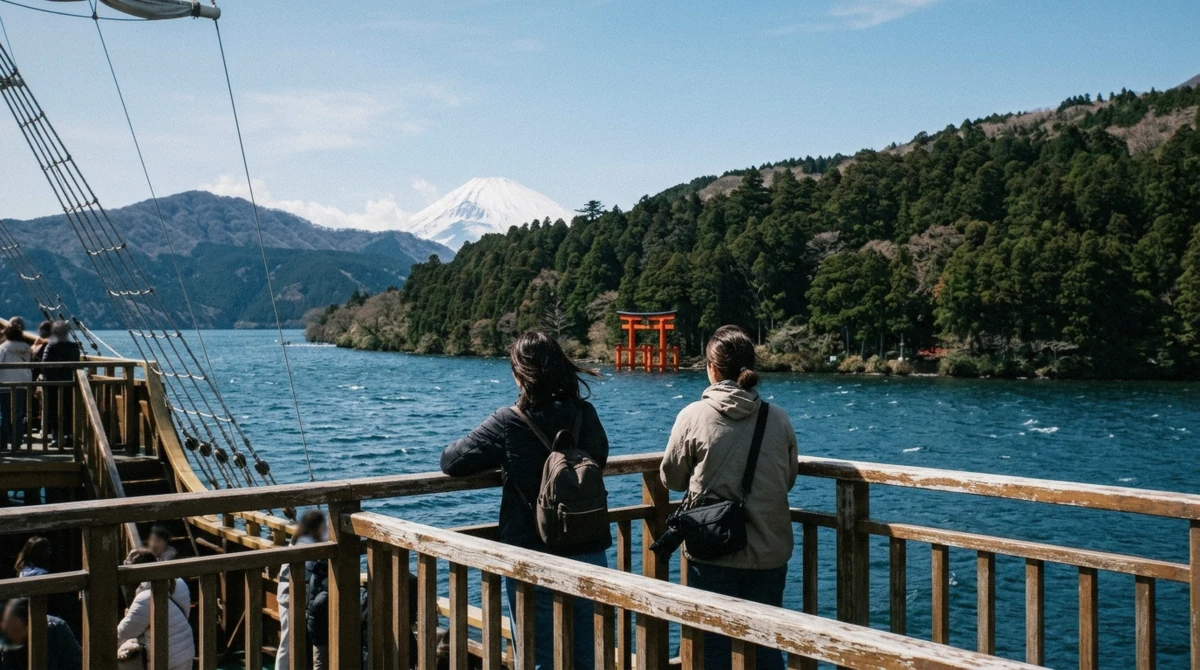
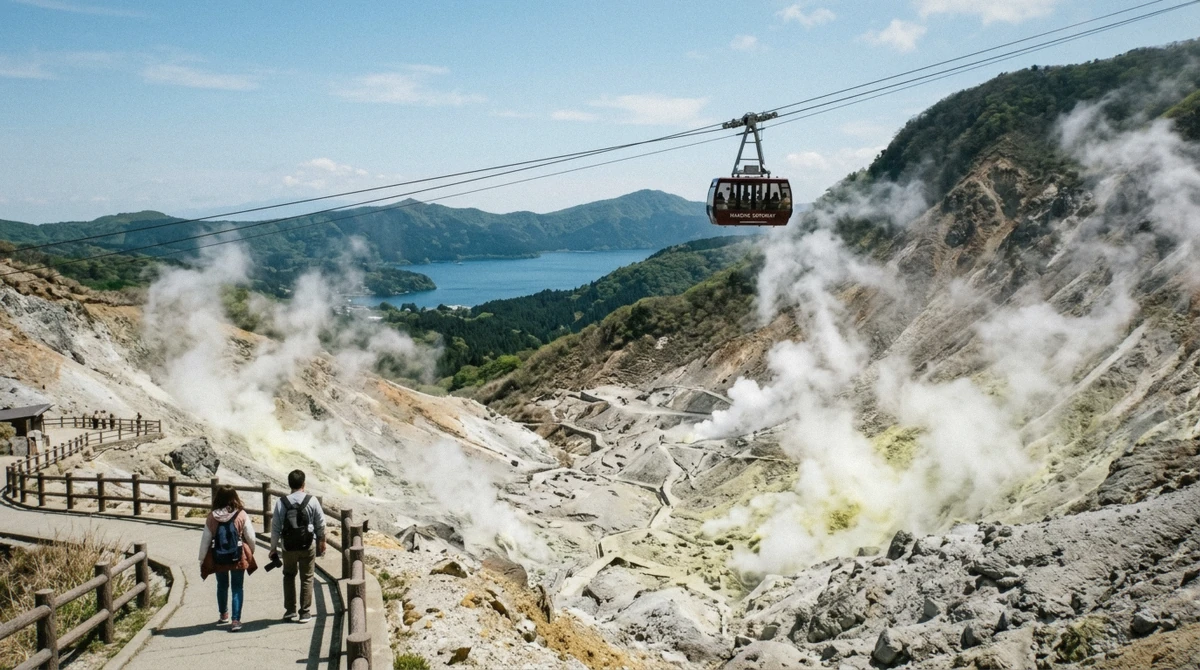
The lake crossing itself is the centerpiece: open water inside a volcanic caldera, a reconstructed Edo-era checkpoint on one shore and a vermilion shrine gate standing in the water on the other. The ropeway leg above Owakudani adds sulfur vents and, on a clear day, the closest view of Mount Fuji most visitors get without climbing it.
What makes the day worth the cost is that all three, the water, the volcano and the mountain, sit on one connected loop reachable in a single outing from Tokyo, which few day trips in the region manage.
What sets it apart from a single-sight trip
Most day trips out of Tokyo center on one destination: a temple, a garden, a single museum. Hakone's loop stacks three genuinely different landscapes end to end, a lake, a volcanic valley and a mountain view, so a traveler who only has one slot in the itinerary for a day trip out of the city still comes home with more than one photograph and more than one story. That density is a large part of why the destination keeps its reputation even among travelers who have visited Japan more than once.
The Honest Downsides
What people underestimate
None of these ruin the day, but each one changes what to expect before you get on the train.
- Mount Fuji is not guaranteed. Operators say so in their own terms, and visibility is markedly better in the cold months and at the ends of the day than at midday in summer
- Peak queues at the pier run about fifteen minutes and no individual reservation exists, since only groups of 15 or more can book directly
- Autumn weekends in October and November are the busiest of the year on the loop, which means queues at every transfer point, not just the boat
- The loop is genuinely tight in a single day if you also want to sit and eat rather than transfer straight through each leg
- A day cancelled for fog or wind has no substitute service on the water, which can unravel a tightly timed itinerary
The Case For and Against
What we genuinely like
- One connected loop covers a lake, a volcanic valley and a shrine in a single day
- A genuine Mount Fuji view on a clear day, without climbing the mountain
- Well organised transit for a first Tokyo day trip, once you know the route
- Guided tours with free cancellation up to 24 hours reduce the weather risk
- Reachable and returnable in a single day from central Tokyo
The honest downsides
- Piece-by-piece transport costs add up fast before food or a pass
- Mount Fuji is never guaranteed and is worst in summer haze
- October and November weekends are crowded at every transfer point
- No individual boat reservation; only groups of 15 or more can book ahead
- A weather cancellation on the water has no substitute service
Who it's NOT for: Travelers whose only free day is a hazy midsummer afternoon, anyone with under four hours to spare, and repeat visitors seeking a quiet weekend loop in autumn.
Who Should Go and Who Should Skip It
The split
First-time Tokyo visitors with a full day and reasonable weather should go; the loop delivers a genuinely different landscape from the city in a single connected route. Travelers boxed into a half day between other plans, or chasing a guaranteed mountain view, should reconsider the timing before the destination itself.
Anyone staying overnight rather than day-tripping should also read where to stay in Hakone before booking, since the base changes how rushed the loop feels.
Repeat visitors and families
Travelers who have already ridden the loop once tend to get more out of a second trip built around one specific piece, an extended stay near the lake shore or an off-peak weekday sailing, than a repeat of the full circuit. Families with young children generally do well on the loop: the boat itself needs no walking, the ropeway cabins are step-free, and the shrine grounds at Moto-Hakone are flat and easy to cover at a slow pace.
Hakone or Kawaguchiko
Two different Fuji views
Kawaguchiko sits closer to Mount Fuji itself and gives a bigger, closer mountain when the weather cooperates, but it offers less to do if the peak stays hidden. Hakone trades some of that closeness for variety: the lake crossing, the volcanic valley and the shrine all give the day something to show for itself even on a cloudy afternoon.
For a first Tokyo day trip with only one slot to fill, Hakone's mix of sights makes a cloudy day less of a loss than a Kawaguchiko trip built entirely around the mountain view.
What First-Timers Get Wrong
The mistakes that shape a bad review
Most of the disappointed accounts of Hakone share the same handful of avoidable mistakes rather than a problem with the destination itself. Booking a half day between other Tokyo plans and then rushing the loop is the most common one; the connections work, but only if the day has room to breathe. Treating the Mount Fuji view as guaranteed rather than a genuine possibility is the second, since a hazy day with an otherwise excellent lake crossing and shrine visit still reads as a disappointment to a traveler who came only for the mountain.
The third is underestimating queue and transfer time on an autumn weekend, when every leg of the loop, not just the boat, runs slower than the posted schedule suggests. None of these are reasons to skip Hakone; they are reasons to build slack into the day and to treat the mountain as a bonus rather than the point.
What a Good Day Actually Looks Like
The version that goes well
The travelers who come away satisfied tend to follow a similar shape, whichever tour they book: an early start out of Tokyo to beat the midday queues, a lake crossing timed for the calmer morning window, unhurried time at the shrine at Moto-Hakone rather than a quick photo stop, and the ropeway crossing scheduled for whichever end of the day the forecast favors that week. None of that requires expert planning; it mostly requires choosing a day tour that already builds in that order rather than assembling the pieces independently under time pressure.
How to Book Without Overpaying
What actually saves money
Piecing the day together only pays off if you are already using a Freepass for other legs of the loop; on a single crossing and a single ropeway ride, a budget guided tour with the entry bundled in usually lands close to the same total with none of the ticket-queue time. Travelers who want to combine the day with a coastal stop rather than repeat the standard loop can look at the day paired with Enoshima island instead. Whichever tour you choose, book one with free cancellation and hold it until when to go points to a clear-air window.
Hakone or Kawaguchiko
These day trips compete for the same visitor, and they are not the same thing. Kawaguchiko is about the mountain. Hakone is about a caldera that happens to have the mountain on its horizon.
| Hakone | Kawaguchiko | |
|---|---|---|
| The main event | A crater lake, a shrine torii in the water, a working ropeway over steam vents | Mount Fuji itself, close and dominant |
| Reach from Tokyo | 85 minutes by direct limited express | Around two hours, usually with a change |
| If the mountain is hidden | The lake, the shrine, the checkpoint and the museums still fill a day | Much of the reason for the trip is behind cloud |
| Onsen | Central to the place, hundreds of baths | Present, not the point |
| Best in | Cold clear months for the view, autumn for colour | Cold clear months, and shoulder seasons for the flowers |
That third row is the honest deciding factor. Fuji visibility is not guaranteed anywhere, and Hakone is the option that still works on the day the mountain does not appear. If the photograph is the entire purpose of your trip, Kawaguchiko is the stronger bet on a clear forecast.
Who Should Go, and Who Should Not
If You have one free day in Tokyo and want scenery, not another city
Go. The reach is under two hours and the caldera does not look like anywhere else you will see on the trip.
If You are chasing a guaranteed Mount Fuji photograph
Reconsider. No operator guarantees the view, and the odds swing hard with the season.
If You dislike queues and packed decks
Go in winter, midweek, on the first sailing. Autumn weekends are the opposite of that.
If You want onsen more than sightseeing
Stay overnight rather than day-tripping. See where to stay in Hakone.
If You have mobility limits
It works. The ships are barrier-free, and one listing here is flagged wheelchair accessible.
Questions About Whether Hakone Is Worth It
Is Hakone a tourist trap?
No. The lake crossing, the ropeway and the shrine are genuine sights rather than manufactured attractions, and the fees involved are modest by comparison with similar day trips near major cities. The crowding on peak autumn weekends is real, but that is a timing issue, not a sign the destination is hollow.
Is Hakone worth visiting for one day?
Yes, for a first visit that covers the lake and one ropeway crossing. It is tight if you also want to sit and eat at each stop rather than transfer straight through, since the loop's riding time alone runs about 2 hours 20 minutes.
How many days do you need in Hakone?
One full day covers the core loop. Two days, split across an overnight stay, lets you spread the same sights across two calmer mornings instead of one tightly timed one.
Is the pirate ship worth riding?
Yes, for the setting alone: open water inside a volcanic caldera with a torii standing in the lake on one shore. The 25 to 35 minute crossing is short enough that even a cloudy day rarely feels wasted.
What should you skip in Hakone?
Skip the full loop if your window is under four hours; pick one leg, either the lake or the ropeway, rather than rushing both. Skip the trip altogether on a day with a poor forecast if seeing Mount Fuji was the main reason for going.
Is Hakone better than Kawaguchiko for Mount Fuji?
For the mountain alone, Kawaguchiko sits closer and gives a bigger view on a clear day. For a day trip that still has something to show on a cloudy one, Hakone's lake, volcano and shrine give it more to fall back on.
How much does a day in Hakone cost without a tour?
Piece by piece it runs past 6,000 yen in transport alone once the crossing, the ropeway and the Romancecar are added, before food. A guided day tour starting around 49 dollars often lands close to the same total with the entry bundled in.
Is Hakone worth it if Mount Fuji does not show?
Yes. The lake crossing, the shrine at Moto-Hakone and the Owakudani valley are all worthwhile independent of the mountain view, which is why the loop holds up on a cloudy day better than a trip built solely around seeing Fuji.
Weigh the forecast against the calendar before you weigh the price. A clear cold morning in November makes the cost look small; a hazy August afternoon makes the same loop feel like a long train ride to a hidden mountain. Book on the forecast, not the date on the calendar.
Prices for the crossing itself are on the Lake Ashi cruise comparison.